Put barley and rice together in a pot with 2 cups water. Boil, then simmer, covered, 40 minutes, checking water level. Allow to cool while preparing salad and dressing. Shred fennel, cabbage and apples. Tear kale into small pieces. Rinse, drain, and add beans. Whisk all remaining ingredients for dressing. Fluff rice mixture and add. Toss with dressing and serve. Note: if only eating a portion, save salad separately from rice, beans and dressing. Mix for individual servings.
Target heart rate, hearty recipes, new soaps, and the promise of springtime gigs!
CREATE	1-Feb	Roasted Vegetable Soup
	3-Feb	New Soaps: Oat & Honey Scrub, Citrus Blossom
	12-Feb	Sweet Potato Hash

MOVE	1-Feb	Seniors' Chair Workout
	16-Feb	Am I in the Zone?

SING	21-Feb	Earth Day Concert announcement
Target Heart Rate is the best way to make your training effective. Different zones can be used for different personal goals and different levels of fitness.
Your heart rate is the most accurate form of measuring exertion because it accounts for all aspects beyond the activity itself: the influence of stress, sleep, hunger, dehydration, temperature, and other factors that have an effect on your heart during exercise.
Find YOUR Zone
In order to make your workouts the most effective, you need to know what Zone reflects your own personal exercise goal. That will tell you where your Target Heart Rate should be during exercise, and then you can track it to make sure it gets there. You’ll need two pieces of information to find your Target Heart Rate: Resting Heart Rate and Age.
Use a Personalized Method
A VERY basic method to figuring out Target Heart Rate is 220 – Age x Zone%. This is mostly how the machines at the gym work, and also how the color zones are designated on your fitness tracking watch. However, they are often incorrect because not everyone at the same age is in the same physical condition. And your condition has a lot to do with how your heart works!
That’s why trainers use the Karvonen Formula, which will calculate YOUR personal Target Heart Rate. It starts with a number that is unique and important: the Heart Rate Reserve. Then we can multiply it by the Target Zone in which you want to exercise based on your goals.
The ZONES
Training Zones
Description
% Heart Rate Max
Benefits/ Goals
Duration
1
Easy/Recovery
50-59
improves circulation, helps with heart recovery after exercise
80-120 minutes
2
Weight Control
60-69
improves the body’s efficiency at converting fuel to energy
40-80 minutes
3
Aerobic
70-79
improves aerobic conditioning and lung capacity, expands blood vessels
10-40 minutes
4
Anaerobic
80-89
increases high speed endurance and maximum performance
2-10 minutes
5
Max Effort
90-100
increases maximum performance and speed
Under 2 minutes
Determine which Zone is your goal, then work towards it. Remember that we all have limitations, and that you can also increase your heart rate by making your exercise BIGGER, FASTER, or HEAVIER. Duration won’t necessarily get your heart rate higher, but it can be a factor in making your heart stronger overall.
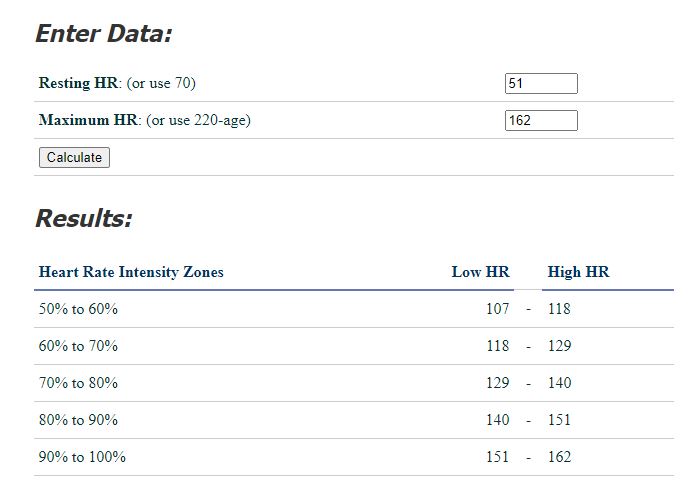
Here is a sample that I made for myself with the online calculator. It gives my target heart range for each zone, which is quite handy once I know which Zones I want to work in! I might use different Zones for different workouts too.
Carol’s Sample Target Heart Rate Chart
The MATH (or skip to the online calculator below)
Terms to know before you begin
Max Heart Rate – the highest that your heart can pump
Resting Heart Rate – your heart rate while you sleep or rest
Heart Rate Reserve – variation from your resting heart rate to your maximum
Desired Intensity Percentage – select % from a category in the Zones Chart above
Training Zone – zones that challenge and develop your fitness for various goals
Target Heart Rate – YOUR personal heart rate goal for each specific training zone
Heat oil on medium. Sauté barley until nutty brown. Add onion and potato. Stir 5 minutes. Add 1/2 cup water, bring to boil, then cover, lower heat, and simmer 20 minutes. Check often to stir and add water if needed. Season with salt and pepper. When soft, remove from heat. Allow to sit 5-10 minutes to absorb any excess water.
Vegans: eat as is. Vegetarians: nice topped with a fried or poached egg. Carnivores can add chicken or steak.
Ingredients are flexible, that’s the beauty of this recipe! I used: cauliflower, carrots, sweet potatoes, zucchini, yellow squash, frozen spinach, a little oil, almond milk and some spices (salt, pepper, thyme, rosemary). But you can use whatever you want!!!
Chop veggies, drizzle with oil, add optional spices and roast at 400F for 50-60 minutes, stirring and adding water midway. Put them in a blender or food processor, add liquid(s) and run until smooth. Spice to your taste.
Calculate at home, with just a soft tape measure and scientific calculator or online calculation links (below). Just be aware that these results will not be 100% accurate, as measurements can vary. Best to do it a few times for an average result.
FOR WOMEN
Measurements (round any fractions to the nearest ½”)
N = Measurement around neck just below larynx protrusion.
W = Measurement around waist at thinnest part between bottom ribs and bellybutton. Breathe normally and measure on an exhale. Do not pull tight.
H = Measurement around hips, running tape over widest part of buttocks and keeping it parallel to floor. Do not wear any compressing fabric while taking measurements!!!
T = Measurement of height in bare feet with chin level to floor and gaze straight ahead. (T=tall)
1) Add W+H. Subtract N. This value will go in the first parenthesis of the equation.
2) Calculate, using a scientific calculator. (Don’t forget to put the parentheses around the values following the logs.) Do not use spaces, as I have done just for clarity.
163.205 log(W + H – N) – 97.684 log(T) – 78.387 = Female Body Fat %
FOR MEN
Measurements (round any fractions to the nearest ½”)
N = Measurement around neck just below larynx protrusion.
W = Measurement around bellybutton. Breathe normally and measure on an exhale. Do not pull tight.
T = Measurement of height in bare feet with chin level to floor and gaze straight ahead. (T=tall)
1) Subtract W – N. This value will go in the first parenthesis of the equation.
2) Calculate, using a scientific calculator. (Don’t forget to put the parentheses around the values following the logs.) Do not use spaces, as I have done just for clarity.
86.010 log(W – N) – 70.041 log(T) + 36.76 = Male Body Fat %
Rinse salmon and pat dry. Lay in oiled pan. Mix sauce ingredients into a consistent paste and spread over fish. Cover and refrigerate about 1 hour. Uncover and bake at 375F for 25-30 minutes, or grill about 8 minutes per side.




 CAROL WING